Oleoresin
Indulge in the epitome of vanilla essence with our meticulously crafted oleoresin and extracts. Produced using our proprietary extraction processes, we offer 1-fold, 2-fold, 4-fold, 10-fold, 20-fold, and 30-fold concentration options with intense, true-to-bean vanilla flavor and a complex profile with layered undertones. Perfect for enhancing chocolate confections, elevating fruit-based creations, and adding depth to savory masterpieces, it is the secret choice for high-end restaurants, artisanal food producers, and passionate home chefs.

Oleoresin at a glance
Oleoresin from Vanilla Fair: Oleoresin and Extracts, Madagascar vanilla cured at our Maroantsetra production sites. Supply is on quotation, from 50 kg per order, with specification sheets and samples on request. We export worldwide; our main markets are France, Germany, the United States, Canada, Japan, South Korea and the United Arab Emirates.
Estimate the quantity for your recipe or production with the formulation simulator; grades, curing and extraction terms are explained in the vanilla lexicon.
Available in
- Format
- 20x · 30x · 40x
- Format
- 100 · 200 · 400 g/L


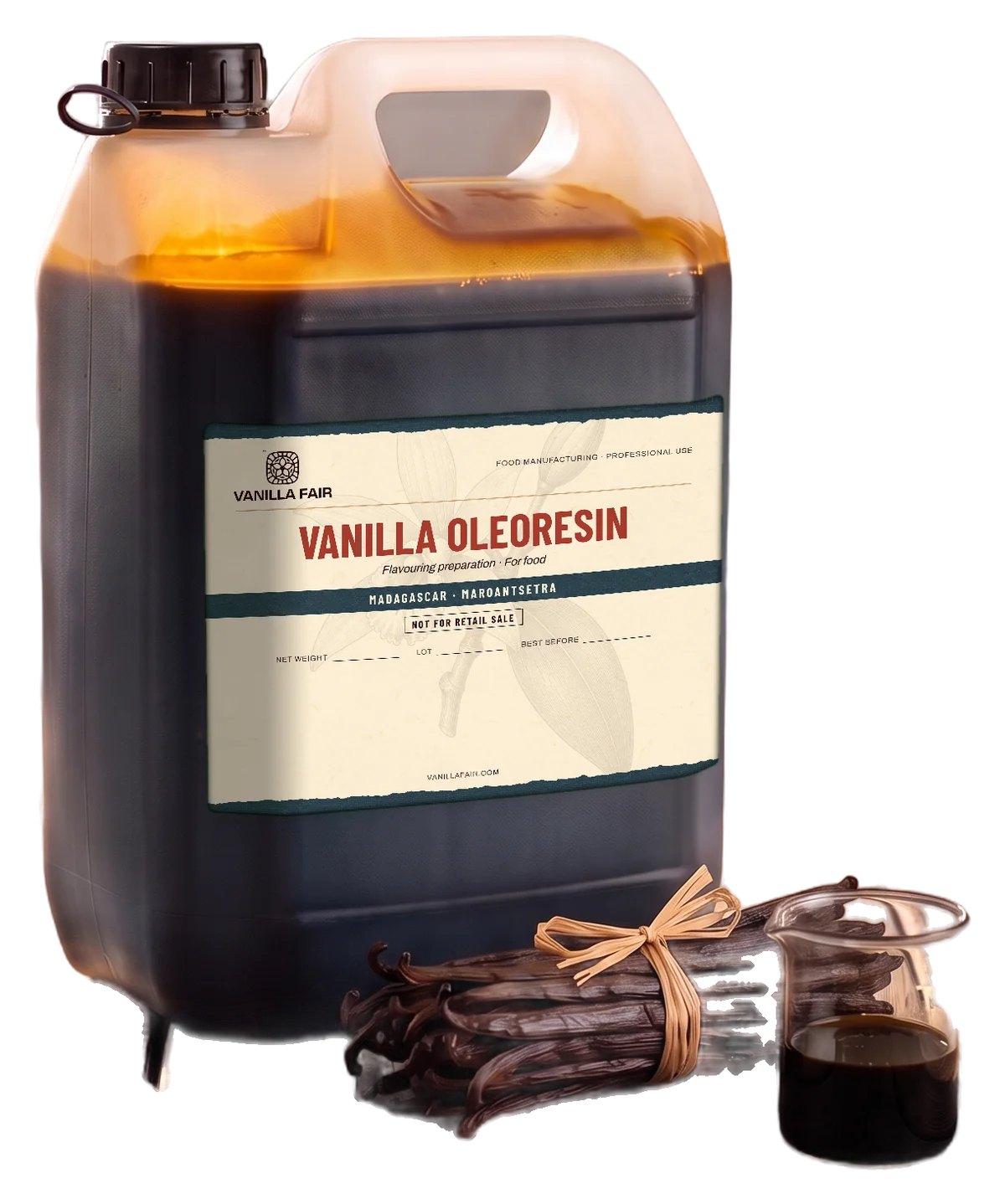
Vanilla oleoresin
A dark, viscous, oil-soluble concentrate of Bourbon Madagascar vanilla beans with a strong natural vanilla taste, used in industrial flavourings, fragrances and cosmetics.
Buyer's guide
What is vanilla oleoresin?
Vanilla oleoresin is a concentrated form of natural vanilla: beans are extracted with a solvent, then the solvent is evaporated until a dark, viscous concentrate remains.
Vanilla Fair's premium Vanilla Oleoresin is obtained by solvent extraction of Bourbon Madagascar vanilla beans, after which the solvent is removed: a dark, viscous, oil-soluble and alcohol-free concentrate with a strong natural vanilla taste, for industrial flavourings, fragrances and cosmetics.
Which solvents are used?
The conventional route percolates beans with aqueous ethanol (30 to 40% vol.) for 48 to 72 hours, then concentrates the extract under vacuum, with temperature under control to avoid degrading the oleoresin1. Supercritical carbon dioxide is increasingly used because it avoids alcohol residues2; published trials run it at 20 MPa and 40 to 60 °C3.
In the EU, ethanol, carbon dioxide, acetone, ethyl acetate, propane, butane and nitrous oxide are authorised for all food uses under good manufacturing practice: only technically unavoidable residues, harmless to health. Other solvents carry caps, such as 1 mg/kg of hexane in the final food4. In the US, spice oleoresins may carry at most 30 ppm of acetone, 25 ppm of hexane or 50 ppm of isopropyl alcohol5.
What do 20x, 30x and 40x mean?
Our oleoresin sheet lists 20x, 30x and 40x. In US law, "fold" is defined for vanilla extracts, flavorings and powder: one fold is the extractive matter of 13.35 oz of beans at 25% moisture or less per US gallon, about 100 g of beans per litre6. For oleoresins the "x" is a trade convention, not a legal definition, so ask how it is calculated and which vanillin level each grade guarantees. Fold alone does not predict dose: a US flavour house gives the same 0.05 to 0.10% starting level for its 10-fold extract and its 20-fold oleoresin7.
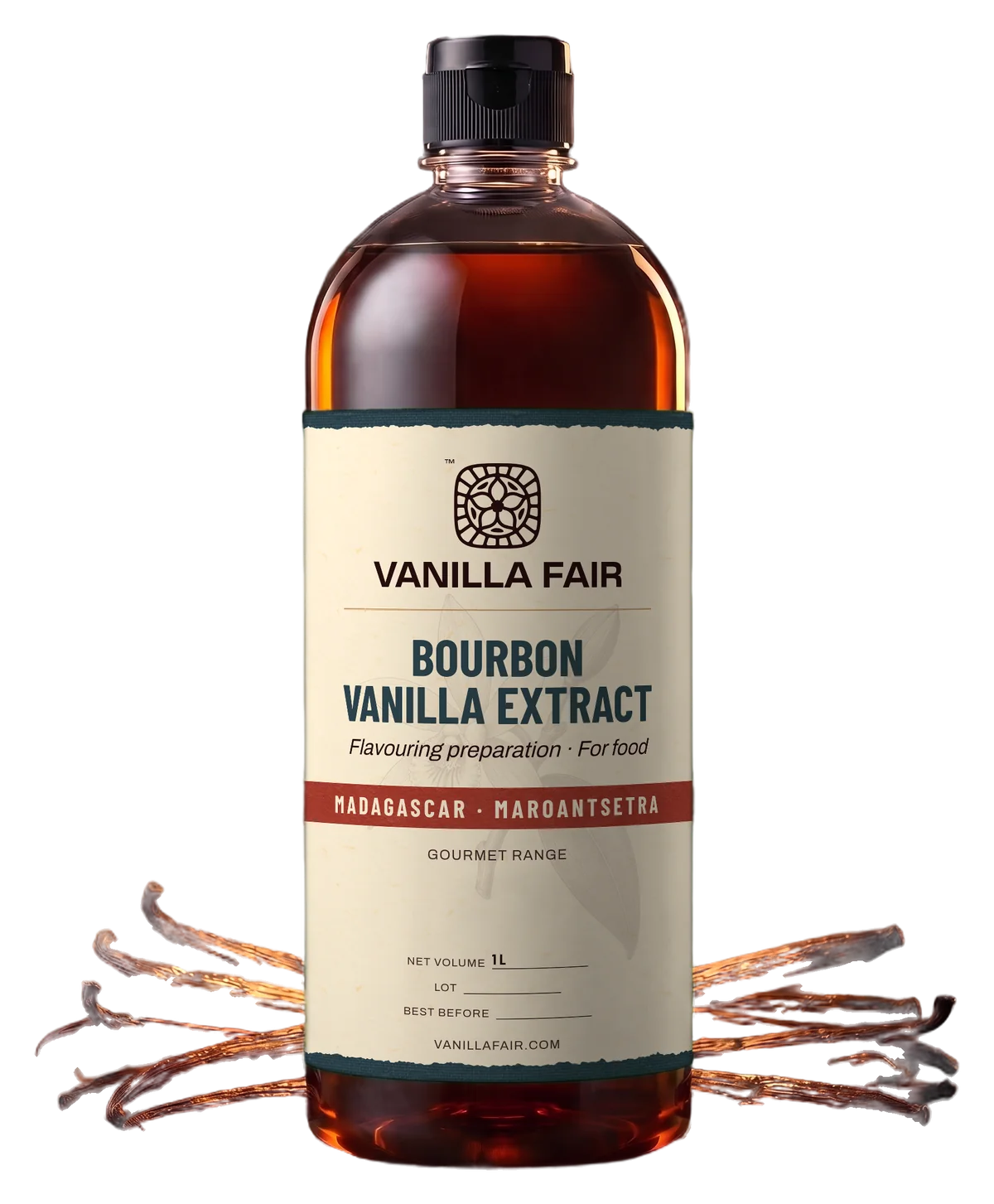
Our sugar-based vanilla extracts are specified in g/L: 100, 200 and 400 g/L, with or without seeds, plus an organic 200 g/L. French pastry suppliers state strength the same way: one gives 200 g of Bourbon pods per litre8, another sells sugar-based L200 and L400 extracts9. Ask us how each of our strengths is defined.
Applications and dosage
Our sheet gives, for the oleoresin range: ice cream base 0.05 to 0.1%, bakery 0.03 to 0.08%, beverages 0.02 to 0.05%, confectionery 0.04 to 0.09%. Validate them in your matrix, then size your needs with the formulation simulator.
Regulatory status
In the EU, an oleoresin extracted from cured beans with an authorised solvent is a flavouring preparation made from food, which needs no Union-list approval; "natural vanilla flavouring" requires at least 95% of the flavouring component from vanilla10. In the US, a spice oleoresin is a natural flavor11, and an extract diluted from it must say "Made from" or "Made in part from" vanilla oleoresin12. See our guide to natural vanilla flavouring labelling, EU vs US.
Storage and ordering
Vanillin is unstable with oxygen, light and humidity2: keep the oleoresin closed, away from light, at +12 °C to +19 °C, for 12 to 24 months. Oleoresin and extracts come in bottles of 1 L, 2 L and 10 L, or drums for bulk orders. Quantities are limited: request a quotation and samples early.
Questions buyers ask
Which solvent is used to make vanilla oleoresin?
The conventional route uses aqueous ethanol, and supercritical CO2 is increasingly used; any solvent must meet EU and US solvent rules. Our sheet states that the solvent is removed after extraction; the certificate of analysis should name it and its residue.
Is there a minimum order for oleoresin?
Liquids are quoted per project and quantities are limited: share your annual volume and destination with your request.
Sources
Industry and regulatory facts, each with its source. Vanilla Fair figures come from our product sheets.
- Romero de la Vega et al., The Journal of Supercritical Fluids (2016), Supercritical CO2 extraction of vanilla (CONICET open-access copy)
- Hernández-Fernández et al., Foods (2020), Vanilla: review of production, composition and preservation (PMC7599886)
- Hernández-Fernández et al., CyTA Journal of Food (2019), Volatile compounds and fatty acids in oleoresins from Vanilla planifolia obtained by supercritical CO2 extraction
- EUR-Lex, Directive 2009/32/EC on extraction solvents, consolidated 16/02/2023
- eCFR, 21 CFR Part 173, Subpart C (173.210 acetone, 173.240 isopropyl alcohol, 173.270 hexane)
- eCFR, 21 CFR 169.3 Definitions (unit weight, unit of vanilla constituent)
- Flavorchem, Vanilla Oleoresin O.C. 20-Fold (93.019OC) and Pure Vanilla Extract 10-Fold (93.145)
- Valrhona Sélection, Comment choisir la meilleure vanille pour vos recettes pros ?
- Eurovanille, Catalogue PIC FR 2025
- EUR-Lex, Regulation (EC) No 1334/2008 on flavourings, Articles 3, 8 and 16
- eCFR, 21 CFR 101.22(a)(3) natural flavor
- eCFR, 21 CFR 169.175 Vanilla extract